Trade It Up!! is a visual novel trading simulator. You, the TRADE IT KID, have to find and trade various items with wacky townsfolk. Find a good present for your sister before her birthday in one week!
This was a completely solo project by myself, Sammi. It was conceptualized in late 2021 and development began in early 2022, with development coming to a halt in 2023.
Trade It Up!! was programmed in Ren’Py, a visual novel engine that uses Python. Art and UI assets were drawn in Procreate by me. Background art assets were manipulated CC images to give a more stylized aesthetic. Music and sound effects were sourced from CC sound effects and music libraries.
Trade It Up!!’s concept came from the story of One Red Paperclip. I’d originally heard of the saga from a YouTube video that playfully attempted to replicate the events in Nintendo’s Animal Crossing: New Horizons. I had experience in the visual novel realm before, particularly in Ren’Py, even completing a comedy dating sim for a Twitch streamer in 2019.
I’ve always enjoyed resource management simulation games, especially those that reward the player for paying attention. I also thought a visual novel wherein you could talk to different quirky NPCs would fit the vibe of the game well. After all, it’s not exactly about the destination, but the journey, and the friends you make along the way.
In order to give the game some replay value, I knew I had to scale down the concept and modify it in certain ways. For example, I found the idea of paperclip -> house a little boring, if repeated ad infinitum. And because I wanted this game to be focused on 100% completion, I needed players to be incentivized to come back by offering different experiences on each run through. This is why I capped the game at a timeline of 7 in-game days, not every NPC is available in every run (determined at random by their “spawn rate”), and the sister character would have different tastes for her birthday present each time, ensuring there was never one “optimal route”.
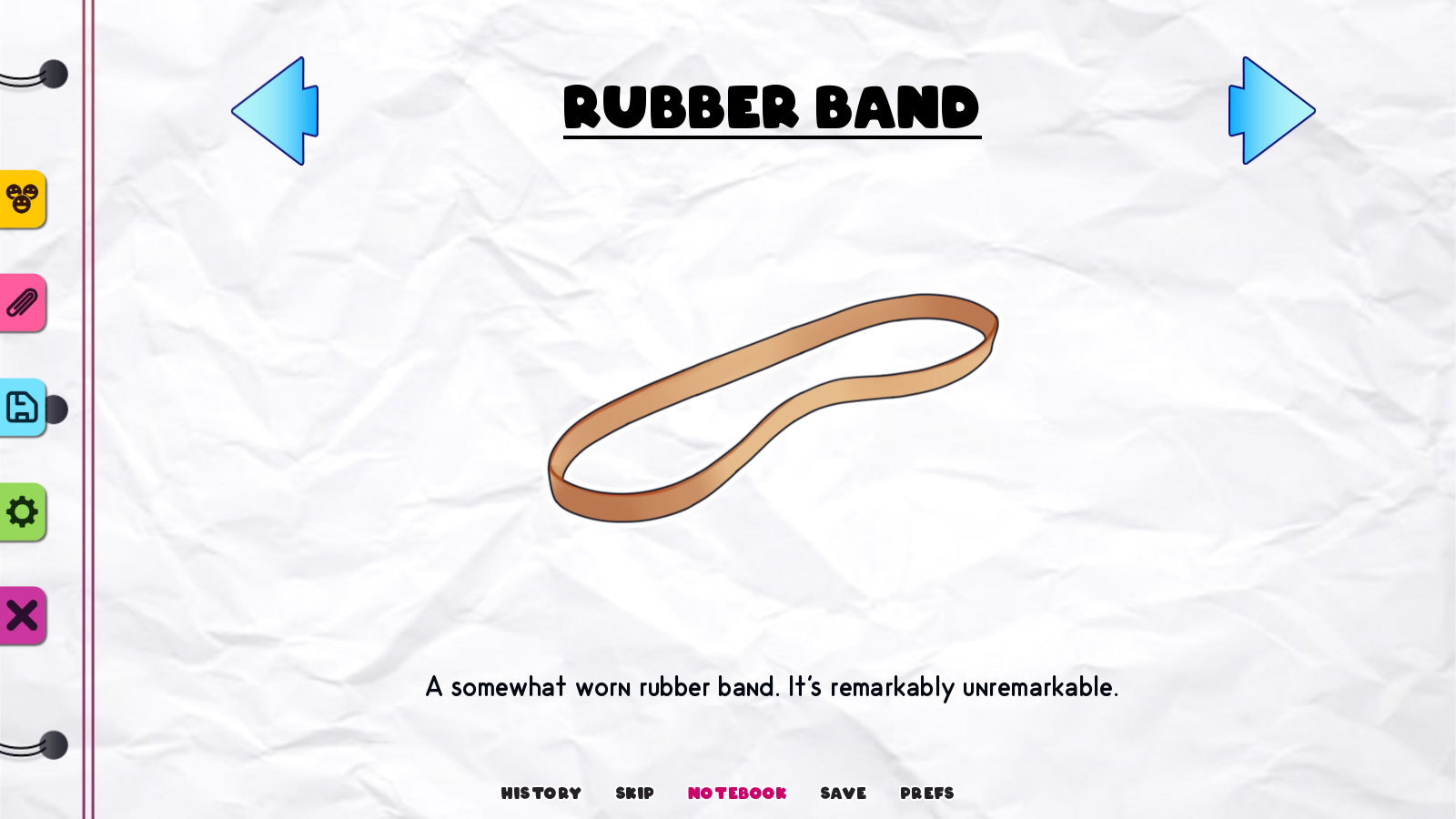
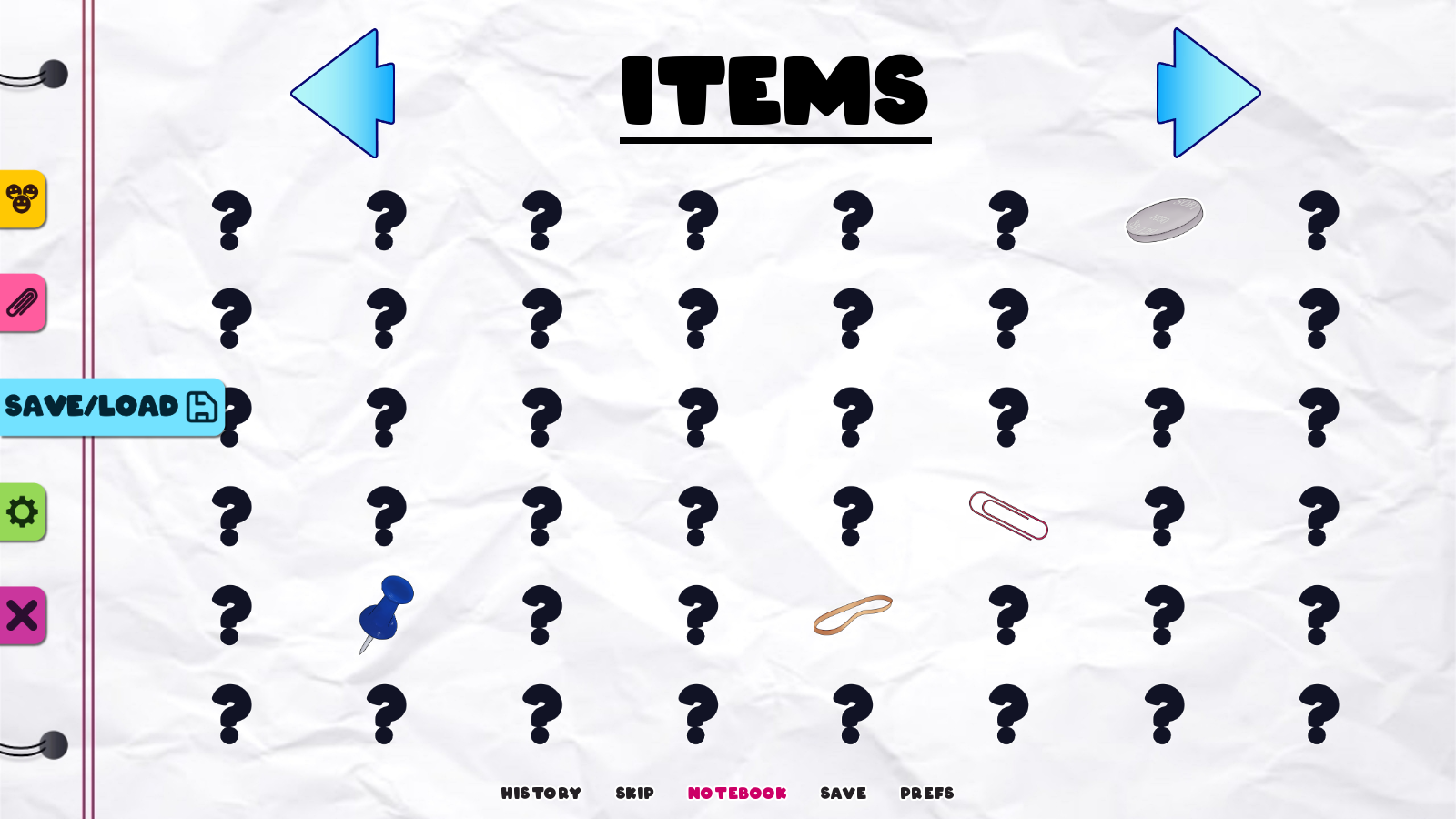
The basic gameplay loop would progress as follows: The player would start a new game, pick one basic item to start with, then spend 7 in-game days (3 visits to NPCs and 1 trade per day) to end up with a different item that either had a higher value or a different “type” which could then be traded for something better. All the while, the player’s notebook would be filled out as they learned information about the NPCs and items they’d collected. This notebook data would persist between playthroughs, encouraging players to talk to everyone and try to discover as many items as they could.
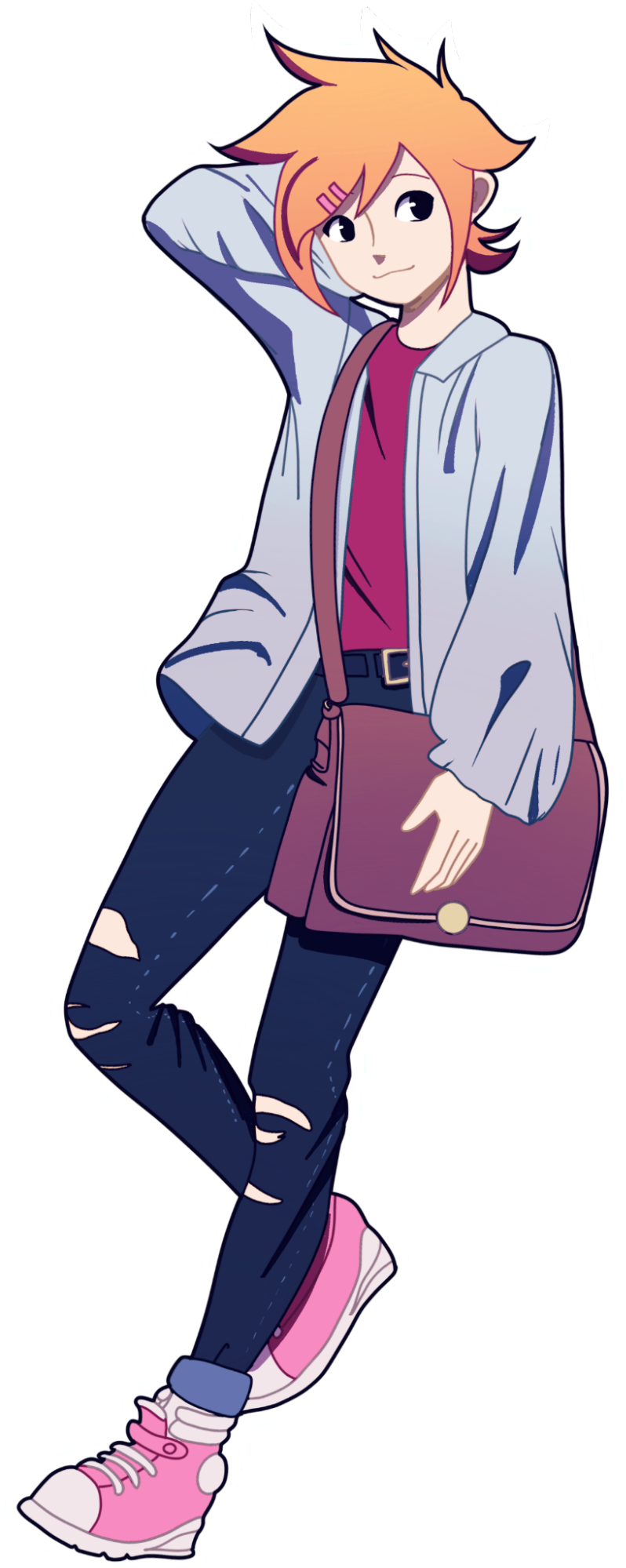
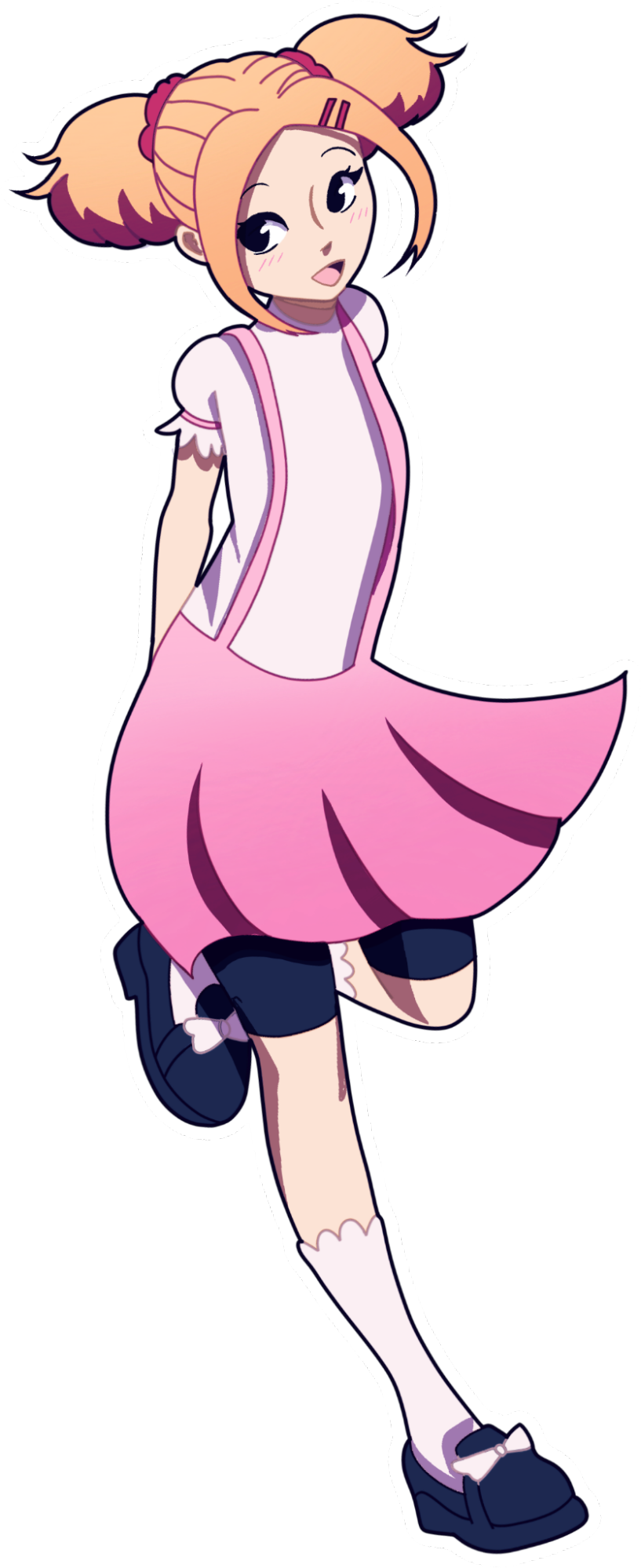
The process began with dreaming up a cast of characters. The main character and their sister were easy enough, with their designs feeling almost second nature to me.
The main character would never have any kind of gender-specific features, including a given name. It was important to me that all people playing could feel represented by the MC, but this would also be more visual-novel than true RPG, so the player’s dialogue was never meant to be flexible. You were playing alongside the Trade It Kid, and you could envision them however you wanted.
Then came the townsfolk. 15 total NPCs that could be talked to and bartered with seemed like a reasonable number, especially when I could then ascribe them one of 5 types that their items (and item preferences) could be associated with. The types I decided on were:
Any item I could think of could pretty quickly be sorted into one of these five groups, as well as characters. Five types of character, and 3 of each type, was a good design choice that gave me a lot of room to move around but also kept me grounded and limited. Each character would have a low value item, a mid value item, and a high value item. Based on their preferences, they would be willing to go up in value for types they liked, and would only go down in value (or reject trades outright) for item types they disliked.
I made a spreadsheet detailing each character, which would allow me to view all of their information at a glance and ensure nothing felt too samey. Each character has a title – something snappy that would give a very clear picture of who they were. Many of the characters had titles first, then designs would come later. It allowed me to rapid-fire concepts for funny and unique characters, without spending time tweaking visual design nor getting too attached to designs that wouldn’t fit the vibe of the game. “Suspicious Twins” and “Disillusioned Barista” made me laugh, so I went with stuff like that.
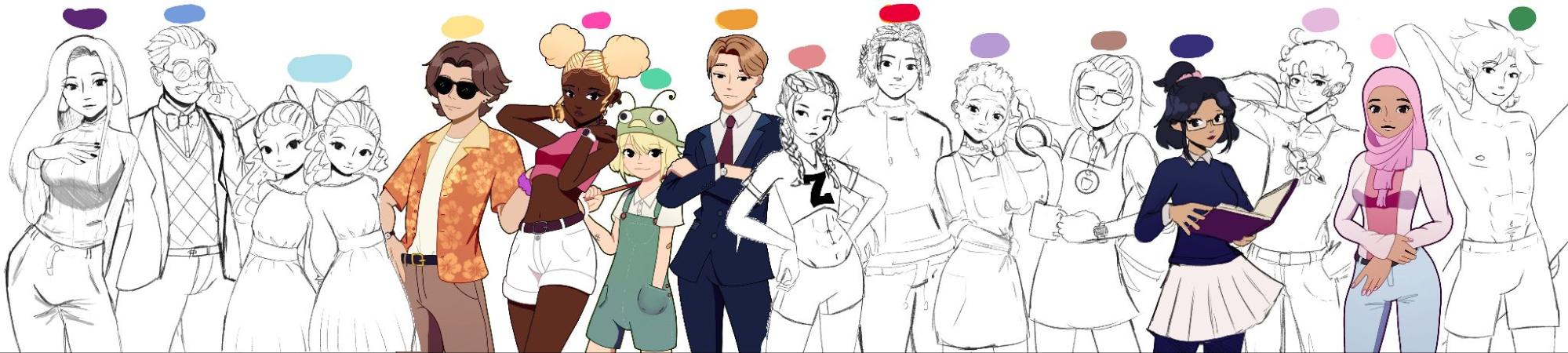
Once I had data visualizations of who these people were and what they liked, I could begin drafting up appearances. I’d had previous experience in visual novel development where each character had different poses depending on the emotions they were expressing, and while I LOVED the concept and felt it made for some great design work, suddenly I had a cast of 15 characters, and any additional poses would mean multiplying my workload by a factor of 15. Trade It Up!! Was conceptualized as a quick portfolio piece, so I ultimately decided against it. That said, I worked to make each character’s silhouette unique and the poses interesting (a common complaint I have against visual novels is that the characters can feel like they’re just “standing there”.) Below is the concept art for each character, as well as the finished portraits for a few:
Ultimately, the idea of the game would only work if the dialogue that supplemented the trades was interesting, so each character needed to have a distinct voice. Despite not making it that far into development, I could still write lines of dialogue for each of these characters on a moment’s notice, because of how fully realized they were to me.
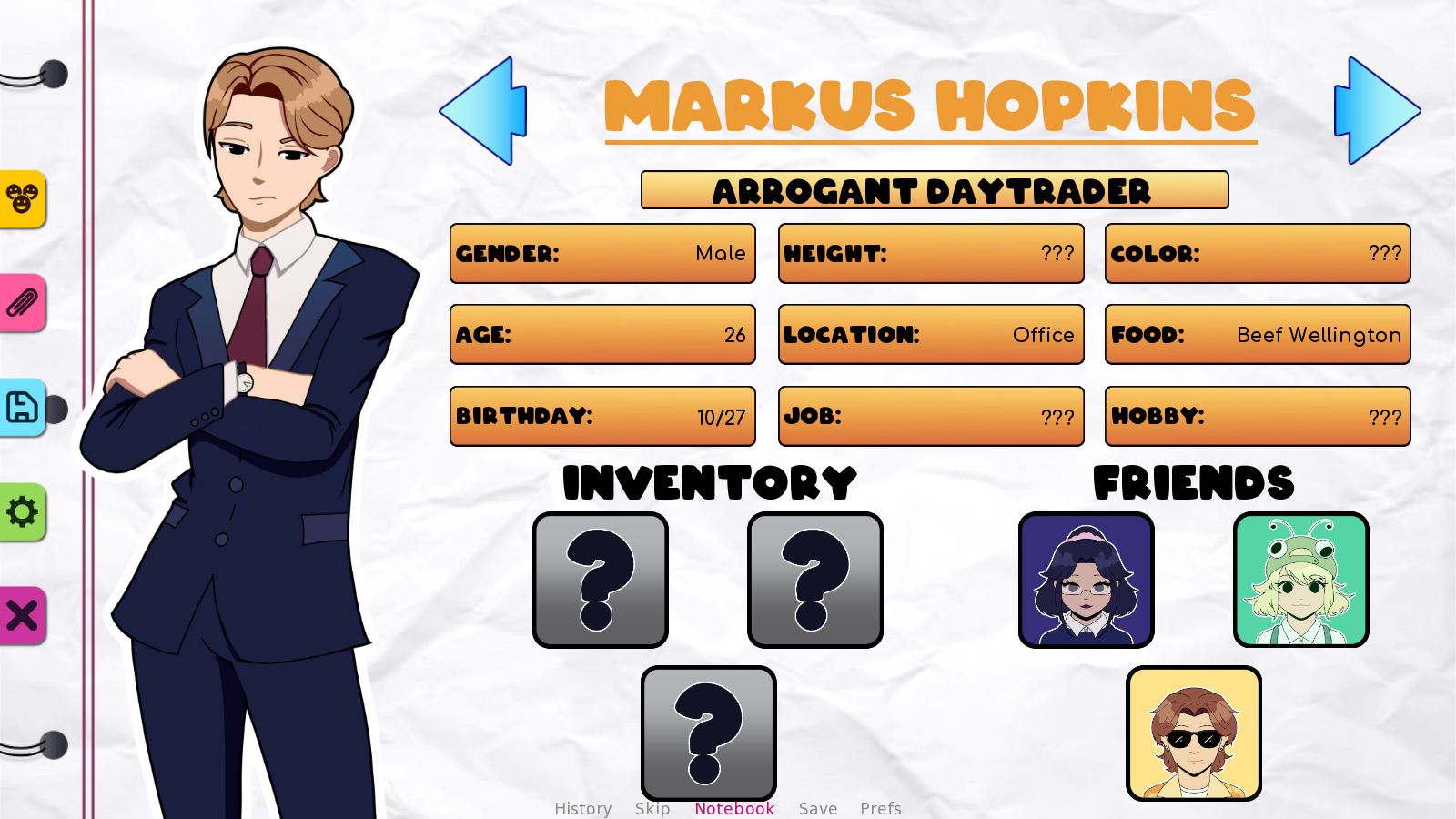
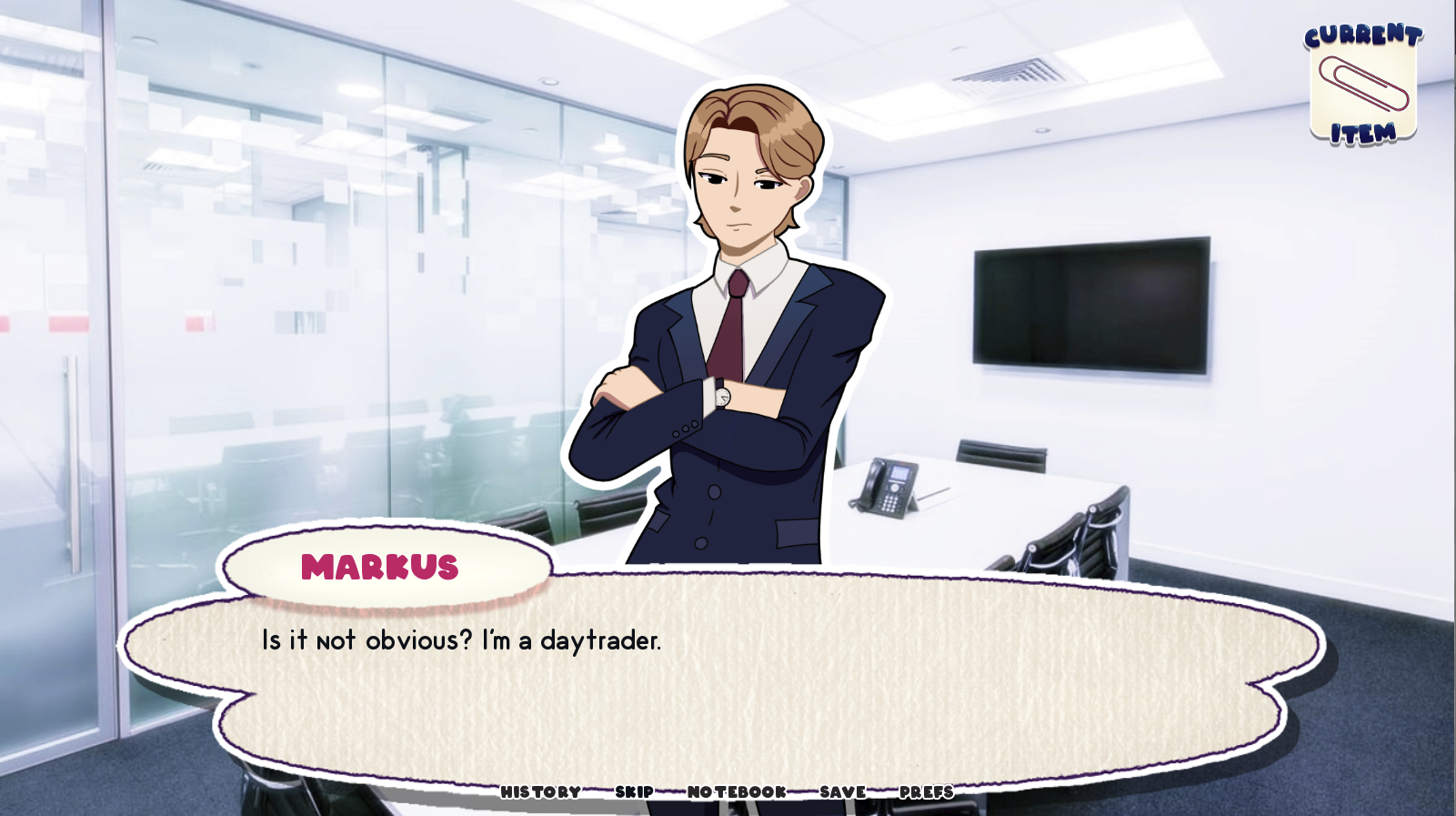
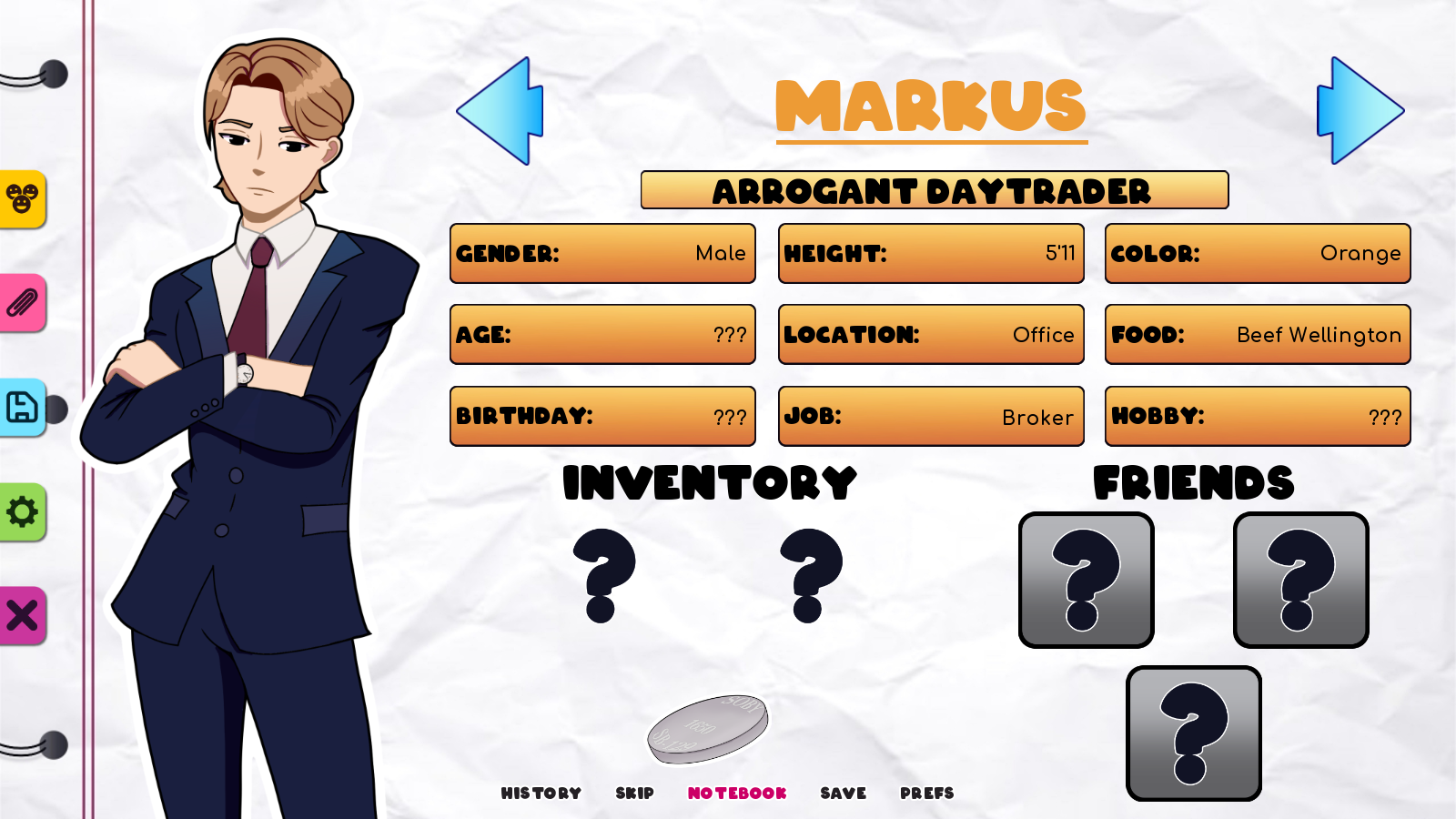
From there, it was a little bit of manipulating Ren’Py (something I had a lot of experience with) to work with Python code (something I had less experience with.) I decided to fully realize the interaction with one NPC, and then I’d base all future code on that example, then tie everything together. (For future reference, Markus, the dashing young man in the suit above, was my test subject, so almost all of my screenshots will revolve around him).
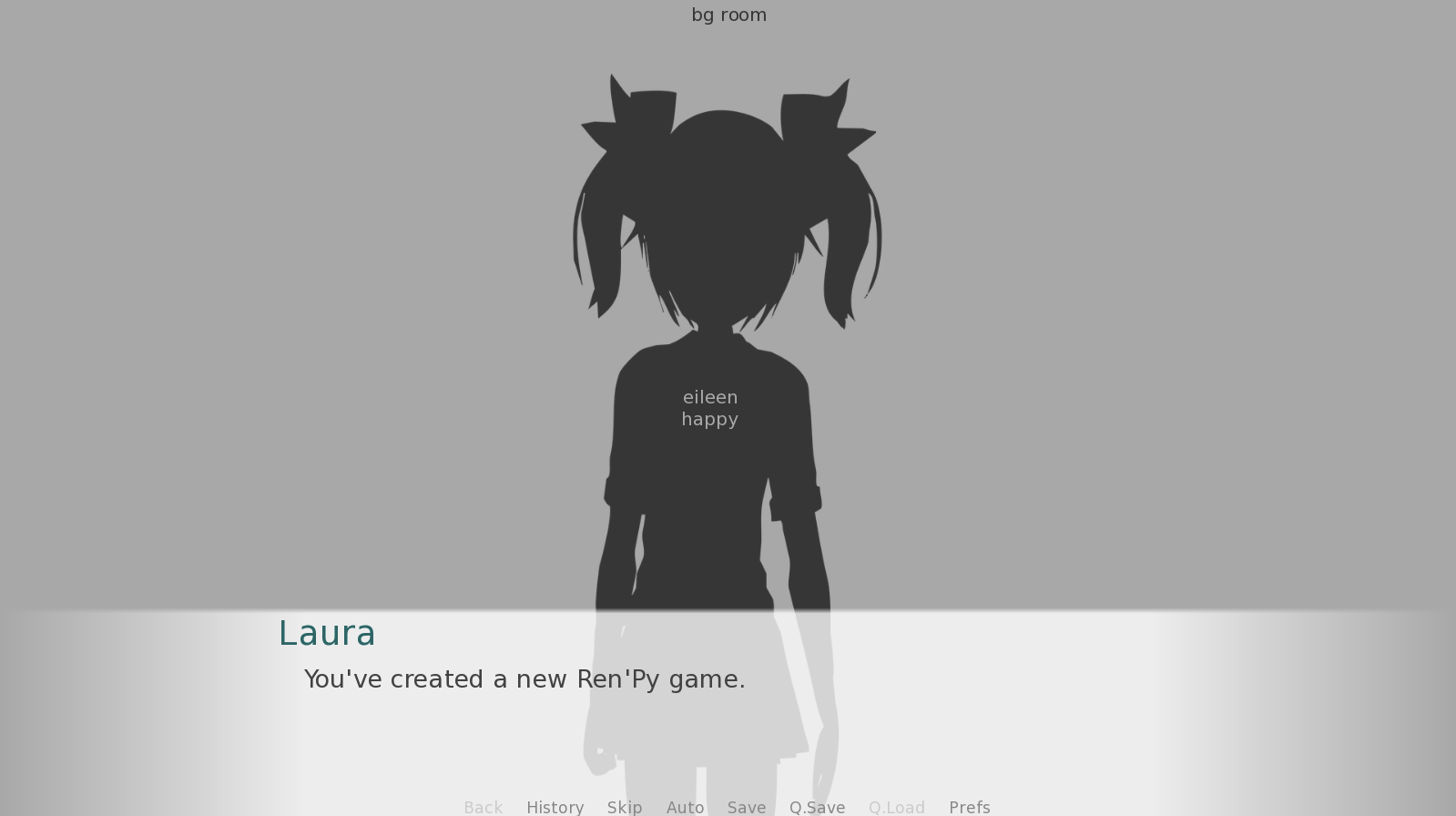
As I worked through development, I also worked hard to give the game a consistent UI. For reference, a Ren’Py game without any level of customization looks like this:
And Trade It Up!! looked like this:
(Complete with idle animation for the textbox, unfortunately not able to be seen in a jpeg.)
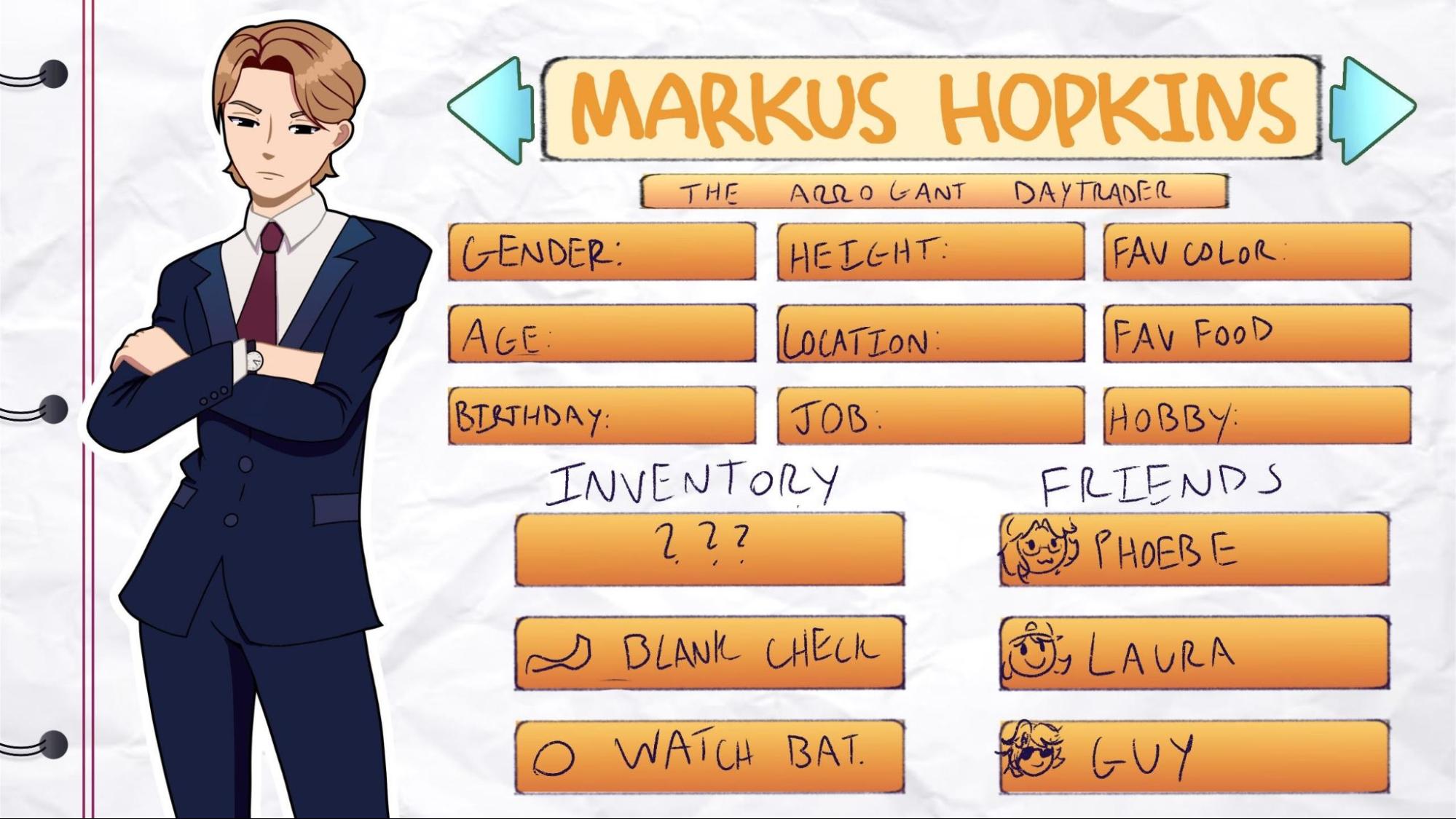
I wanted something reminiscent of a grade schooler’s notebook, one I imagined the Trade It Kid would carry in their bag, keeping tabs on the townsfolk.
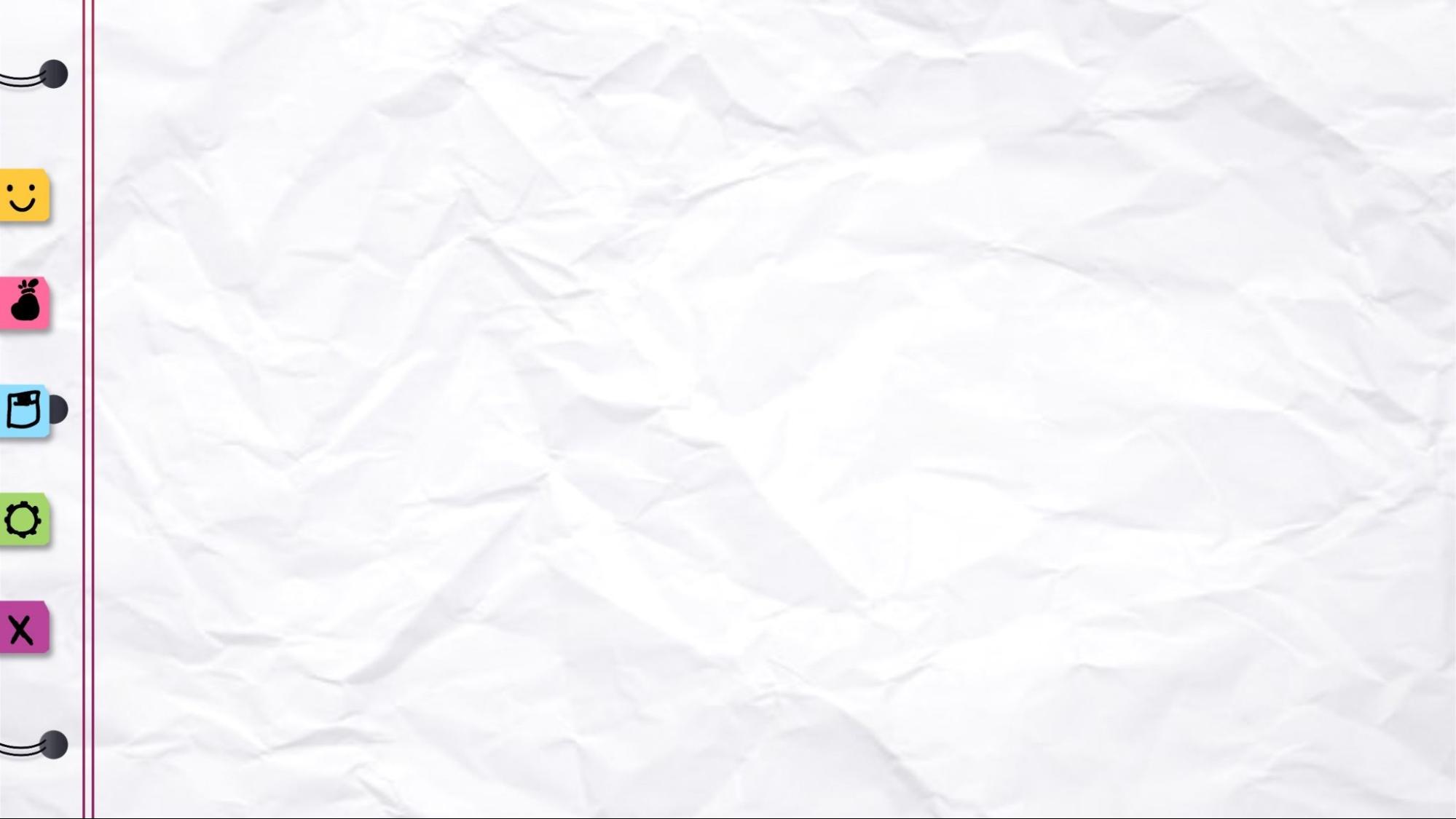
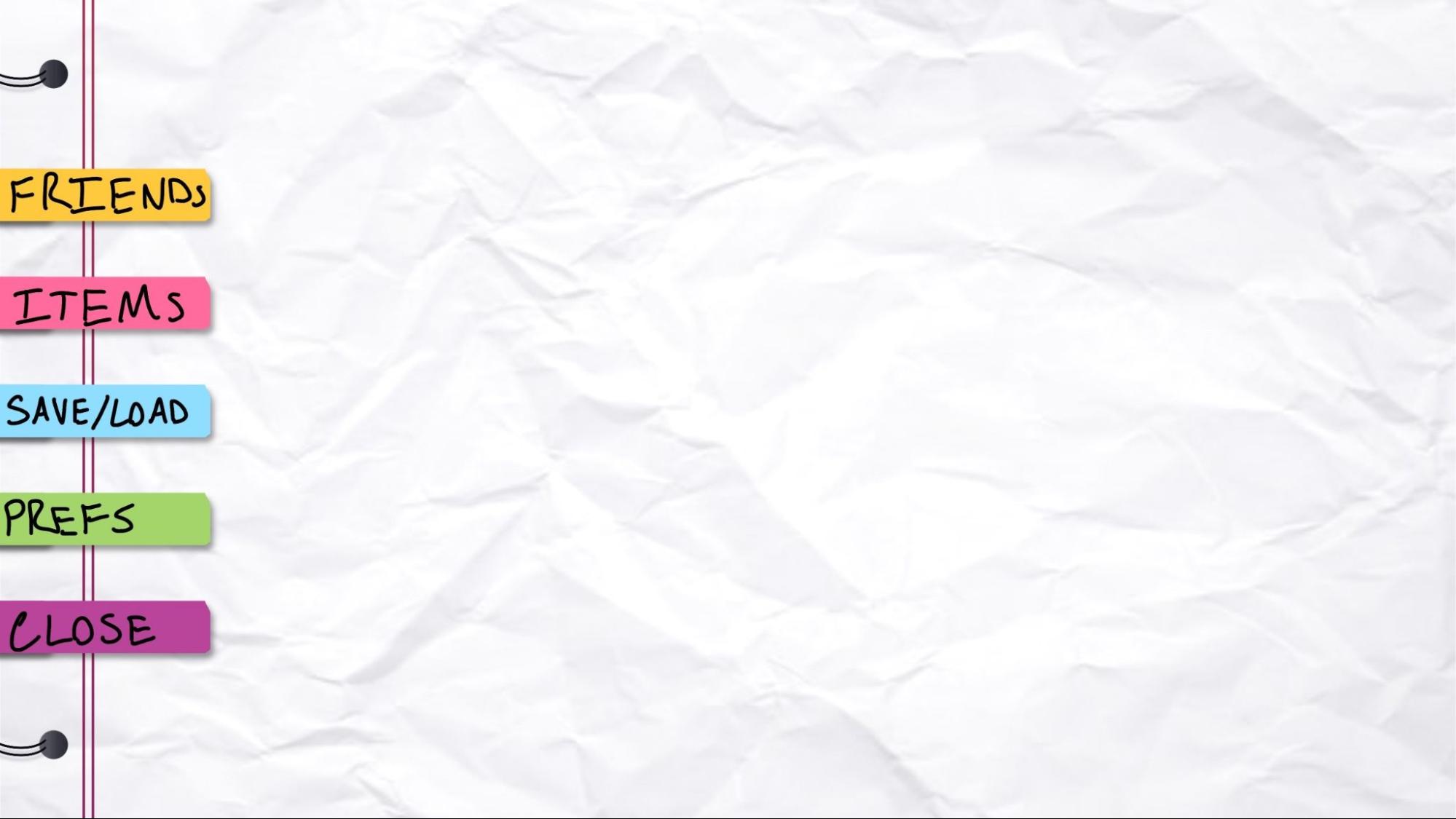
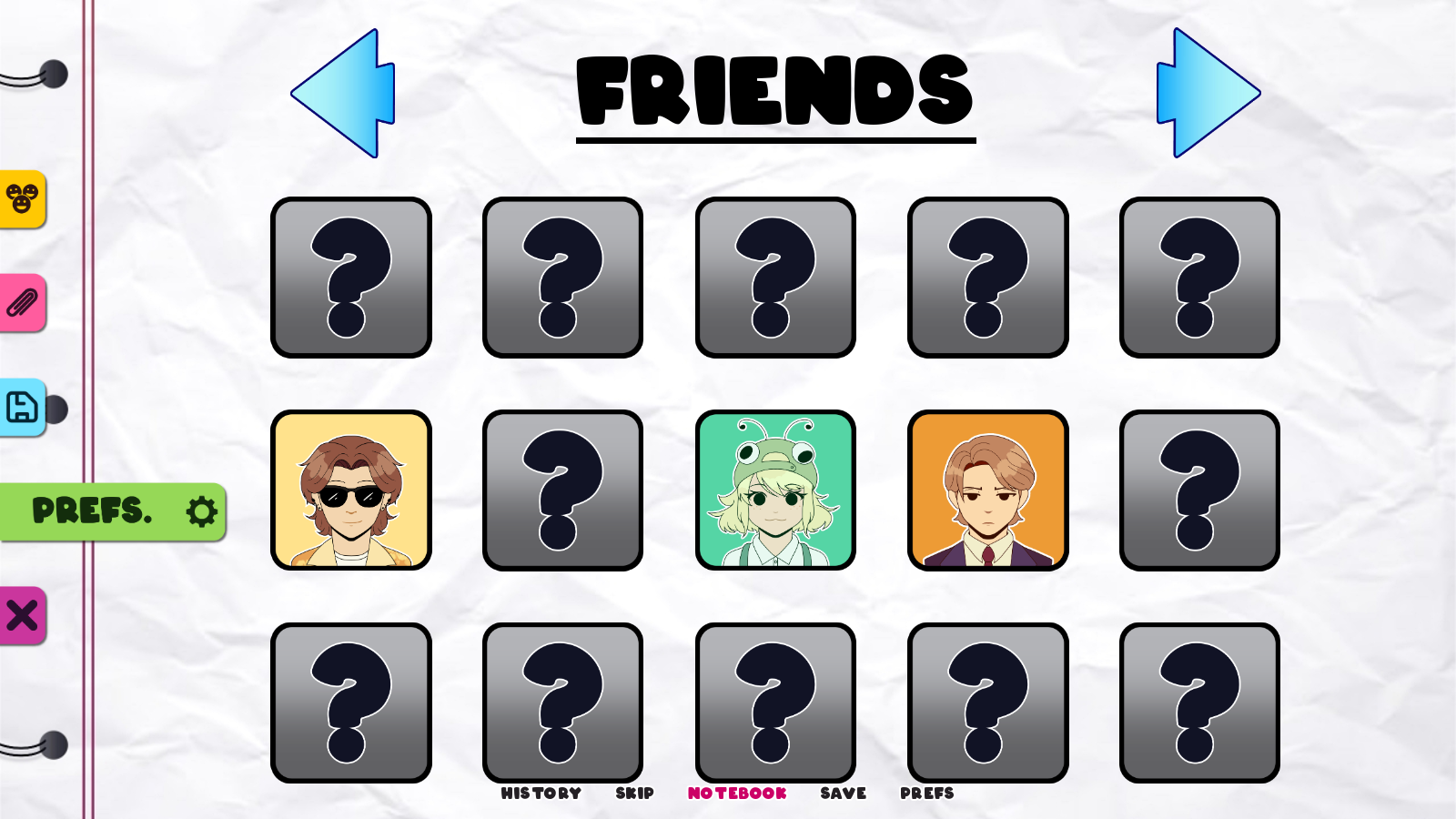
You would cycle through pages of profiles, and as you learned these things about the characters, “???” would turn into information you’d learned. I also had the idea of making the sidebar navigation look like color coded tabs that would pop out when moused over:
These tabs would also eventually be implemented in the main game’s quick menu.
This is the finished notebook UI:
The screens are essentially functions that get passed “who” in as a variable and change information accordingly. The code is awfully spaghetti as of now due to my own status as a junior programmer, but that is where it was always intended to end up after refactoring.
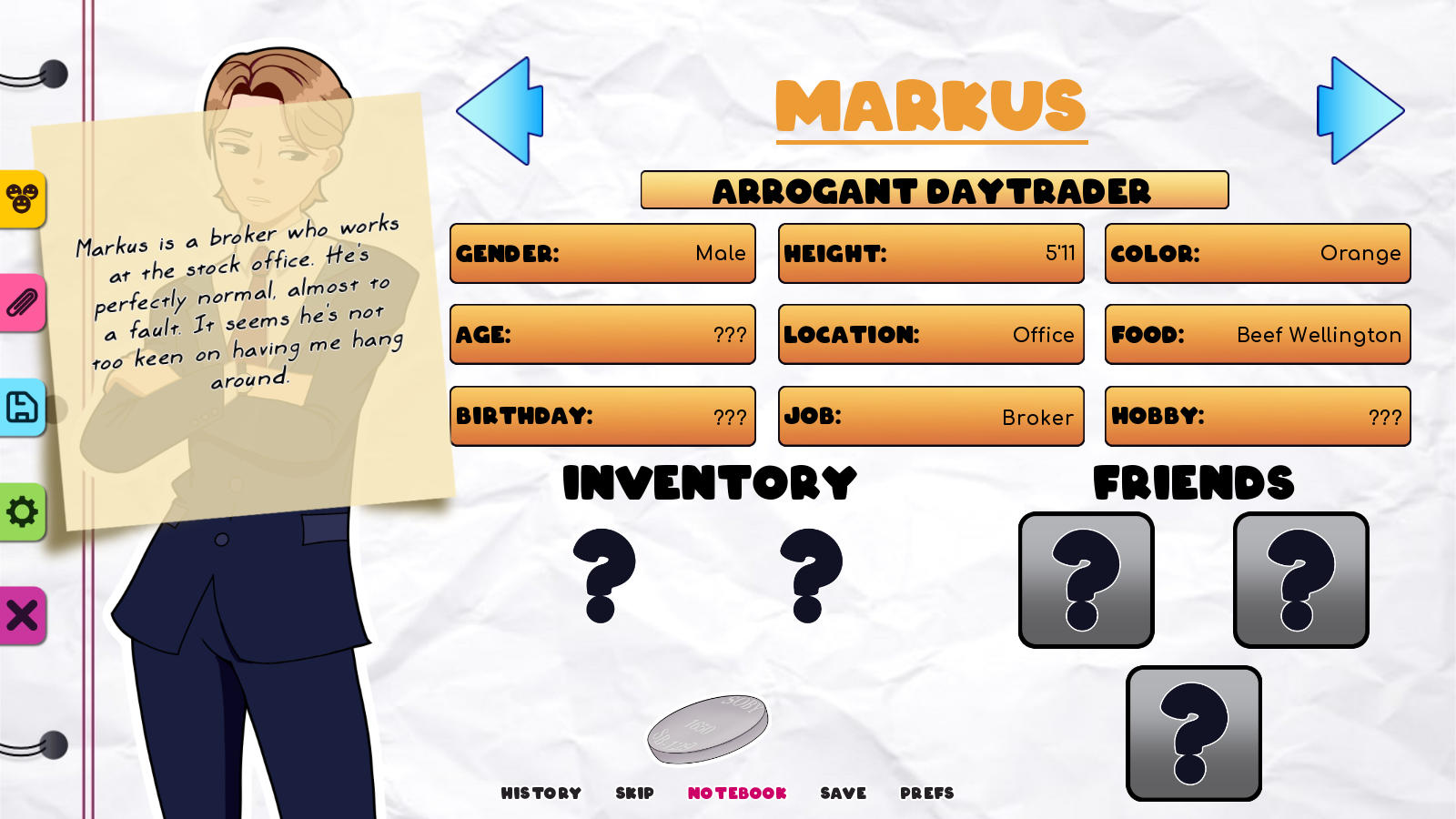
This game also featured an incredibly rudimentary affection mechanic, where the MC would keep post-its regarding their thoughts on the NPCs that would change the closer you grew to them. For example, at 0 affection, Markus’s bio note reads:
“Markus is a broker who works at the stock office. He's perfectly normal, almost to a fault. It seems he's not too keen on having me hang around."
But once his affection is raised all the way, it reads:
"Markus is a really good friend of mine. It's kind of sad - he likes to hide everything about himself that's interesting or quirky. Above all, though, it seems he really cares for his family and his friends. And he even has a soft spot for cutesy stuff - who knew?"
I wanted each subsequent playthrough to show more and more about what you learned, rewarding you for spending time with the game and sinking your teeth into it.
I am still ultimately very proud of this game in concept and the work I was able to put into it. My absolute favorite part is the UI design; unfortunately missed in static screenshots, the entire thing was bouncy and vibrant and very interactive – I think it matched the vibe I was going for perfectly and is still a very solid design. I liked my characters and my item concepts, I liked the idea of playing the game and I liked how unique it felt. In general, “vision” is my greatest strength as a director and all of the choices I made for this game align strongly with that vision.
You hear it all the time, especially in the games industry – scope. My worst enemy. For a solo project, I actually think the scope of this project wasn’t inconceivable. It started as a tech demo, and most of the QOL or flourish features I wanted didn’t take much in the way of time. Even working as a solo dev was a boon – I didn’t have to pay anyone for the work I wanted done, I just had to do it. But unfortunately, that was my biggest roadblock. I had to do it. Illustration has always been just a hobby for me, and the amount of assets I planned for the game (15 unique character portraits, 45 unique items, UI elements) were just taking up too much of my time as a full time university student that also wanted to draw fanart and fun things that didn’t feel like work.
I also encountered an interesting problem that I hadn’t expected; my growth as a creative was outpacing the work I was doing. Ideally, you always want to be getting better and refining your tastes, but for Trade It Up!! specifically, my art and programming skills were suddenly miles ahead of where they’d been just weeks before, and it became disheartening to know I either wouldn’t have a consistent level of quality in one project, or I’d have to spend a lot of time refactoring and tweaking and re-doing work I’d already done.
Another issue I’d had was the writing. I’d planned for ~10 little conversations to take place with each character, and when you asked to chat with them, a random one would get picked (with no repeats). This was a concept I’d liked and repurposed from another scrapped game I have, but I ultimately ran into the same problem – the interactions just weren’t up to my standards. Perhaps it’s personal preference, but I get annoyed when I keep hearing the same dialogue over and over again in a game; combined with the fact that a visual novel thrives from pre-scripted story elements that change based on player decision, and these chats had to be accessible at any point, regardless of what had happened (I’d had some special chats written after certain events occurred, like if you found out a character’s special item, you could talk to them about it), it was difficult to come up with enough interesting snippets. Plus, 10 chats for each of the 15 characters would be 150 individual chats…I couldn’t justify it enough to myself, but I was worried there wouldn’t be much left if I cut the concept entirely.
Similarly, 15 was just too large of a cast for one person. Mainly because I had favorites, and I wasn’t able to give each character the love they deserved. I knew an ensemble cast would lend itself to fan favorites, but the key piece of that is “fan” – I didn’t want to release a game where it was obvious I’d had characters I gave more attention to than others.
Trade it Up!! is a novel concept with a lot of potential, and I firmly believe with the right timing and team, it could have been realized beautifully. But a twenty year old college student drowning in exams and internship applications was not the right timing nor team.
I don’t think my career as a visual novelist is over, nor will it ever be. I’ve been playing with Ren’Py for years at this point, with many projects (completed or scrapped) under my belt, each contributing to my development and now being a base of ideas that I can continue to repurpose in innovative ways. That being said, I’ve also gained a lot of knowledge about game design since completing my Bachelor’s degree that has exponentially increased the number of tools in my toolbox – namely, design documents, project management skills, and a network of talent I can now call upon to lighten my workload and thrive in a directorial space. If I were to make another visual novel, I would lean into a predetermined story with branching paths or fully commit to a simulation game (I’ve always wanted to make a dating sim with those old 90s RPG elements, like time management and stat maxing.) For now, I’m shelving Ren’Py and moving to greener pastures. I will continue to document, develop, direct, and play.
Thank you for reading this far. If you’re interested in seeing what’s next for pictoparade, please consider checking out the following: